

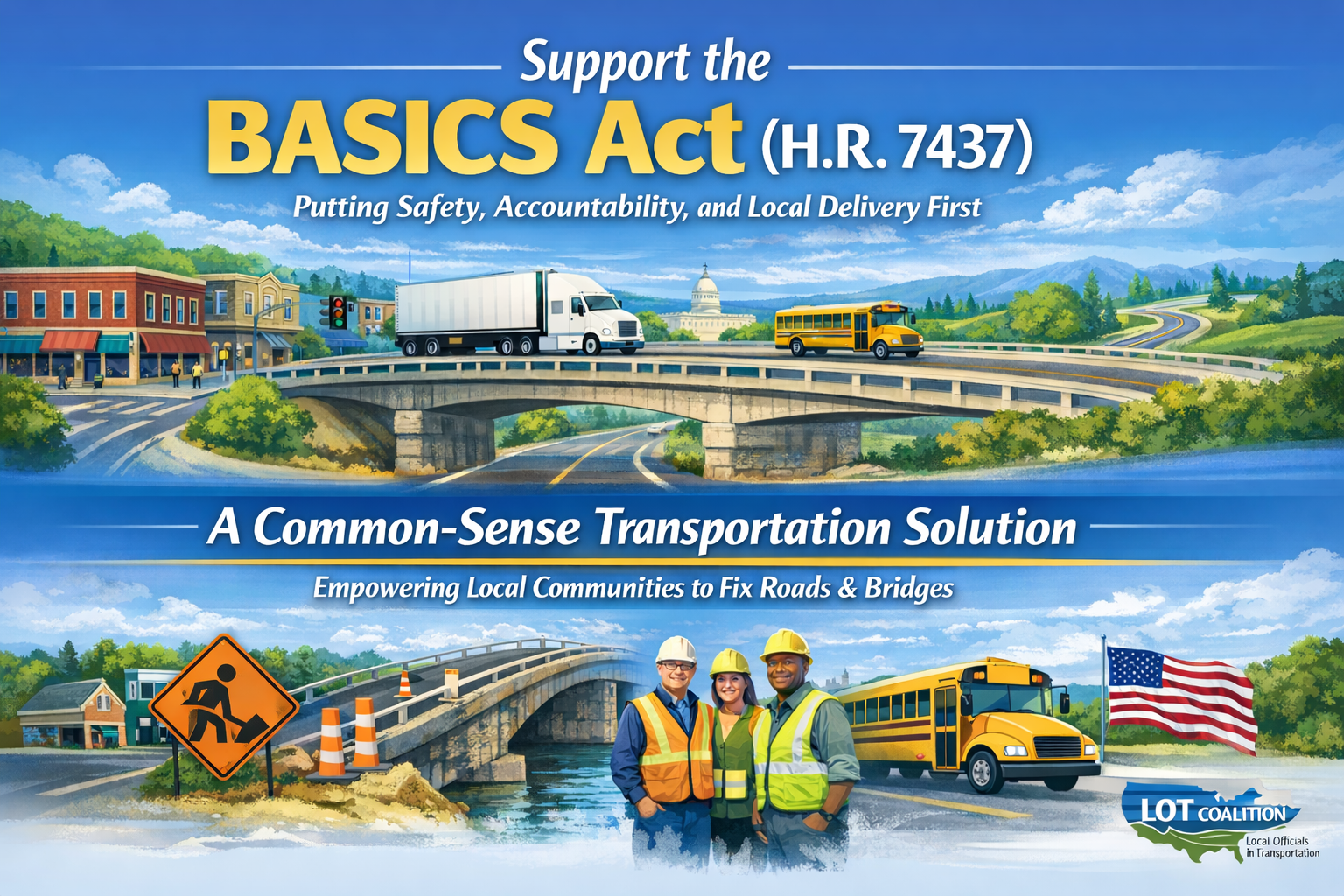
WASHINGTON, D.C. — [February 9, 2026] — The Association of Metropolitan Planning Organizations (AMPO) strongly supports the bipartisan introduction of US House legislation that would ensure that regions and local governments have reliable access to federal funding to plan, deliver, and maintain the transportation systems people depend on every day.
The BASICS Act was introduced by Representative Rob Bresnahan and Representative McDonald-Rivet. The bill updates federal surface transportation programs to better align with how transportation networks actually function, with a focus on safety, accountability, and investments in the roads and bridges most used by communities and businesses.
Local and regional governments plan for, own, and operate the majority of the nation’s transportation infrastructure. These systems support daily travel, regional freight movement, and national supply chains, yet federal transportation funding remains concentrated on a relatively small share of the overall network. The BASICS Act responds directly to this mismatch by strengthening core formula programs, improving regional and local access to funding, and ensuring federal dollars move efficiently to projects that are planned, prioritized, and ready to deliver.
“Local and regional governments are on the front lines of America’s transportation challenges, but too often lack direct access to the federal funding needed to deliver solutions,” said Bill Keyrouze, Executive Director of AMPO. “We thank the sponsors for introducing the BASICS Act, which realigns federal programs with on-the-ground reality and gives regions the tools to fix the roads, bridges, and safety challenges people experience every day.”
The BASICS Act aligns closely with priorities advanced by the Local Officials for Transportation (LOT) Coalition, which represents cities, towns, counties, rural transportation planning organizations (RTPOs), metropolitan planning organizations (MPOs), and regional councils nationwide. Together, LOT Coalition members advocate for federal transportation policies that recognize the central role communities play in planning, delivering, and maintaining the transportation systems that connect people to jobs, goods to markets, and regions to opportunity.
“As AMPO’s Board President, I am pleased to support the BASICS Act,” said Pragati Srivastava. “Transportation extends beyond city and county lines, and regional coordination is essential everywhere. Families commute across jurisdictions, businesses depend on reliable freight corridors, and regions succeed when we plan and invest as a whole. MPOs are where local leaders, state DOTs, and transit providers come together to set priorities based on local needs and data, and to deliver projects that reflect how people actually travel and how goods move. This bill strengthens that work by reinforcing local and regional decision-making and improving access to the core formula funds that regions rely on. It also keeps the focus on the fundamentals: safety, accountability, transparency, and performance.”
The BASICS Act seeks to better align federal transportation policy with how the system actually functions on the ground. The bill would:
- Target bridge funding based on condition and ownership
- Strengthen flexible formula programs for local and regional project delivery
- Direct safety dollars to high-risk roads
- Support both metropolitan and rural transportation planning capacity
- Reinforce accountability and locally driven project selection
MPO leaders across the country emphasized the importance of predictable, locally driven funding to support effective planning and project delivery.
“Southeast Michigan’s transportation system faces the same challenges – safety, the condition of our roads and bridges, and reliable funding – as the rest of our state and the entire country,” said Amy O’Leary, Executive Director, Southeast Michigan Council of Governments and AMPO Board member. “The BASICS Act prioritizes what is needed: reliable funding for a stable and locally-driven transportation planning process, which is the foundation of effective project delivery. This legislation will continue to bring much needed support to fix high-risk infrastructure and balance investment across the transportation system,” O’Leary said.
“In the Michigan Great Lakes Bay region, our work is guided by the continual goal of Moving Saginaw towards a seamless and safe transportation system by bringing communities together around data-driven, regional decision-making that improves safety, preserves existing assets, and expands access to opportunity,” said Demetra M. Manley, the Executive Director of the Saginaw Area Transportation Agency. “The BASICS Act supports this collaborative approach by providing stable, locally driven funding that allows regions to maximize limited resources and advance projects that strengthen quality of life. We appreciate the bipartisan leadership behind this legislation and thank Rep. Kristen McDonald Rivet for championing solutions that reflect the needs of communities like ours,” said Manley.
“The bipartisan BASICS Act is a strong step toward addressing Pennsylvania’s real infrastructure needs,” said Lackawanna/Luzerne MPO Coordinating Committee Chair and LCTA Executive Director Bob Fiume. “This legislation would deliver federal investment needed to keep people connected to health care, employment, education, shopping, and more,” said Fiume.
“The federal transportation program is a long-running success story because it’s built on a foundation of core funding formulas,” noted Sue Noack, who chairs the San Francisco Bay Area’s Metropolitan Transportation Commission. “Thanks to reliable and predictable federal support, metro areas all across the country make local investments to meet national priorities and drive the national economy. These include taking proper care of the bridges, highways and other infrastructure that keep our people and our businesses’ products moving safely and efficiently.” Said Noack.
The BASICS Act Toolkit prepared by the LOT Coalition (bill text, bill summary, section-by-section, one-pagers, and additional materials) is available here.
Contact:
Katie Economou
Legislative Director
Association of Metropolitan Planning Organizations
keconomou@ampo.org
Media Contact:
Jessica O’Keefe
Communications & Membership Director
Association of Metropolitan Planning Organizations
Jokeefe@ampo.org
Edited 2/10/26 to add quote from Sue Noack.

Comments are closed.